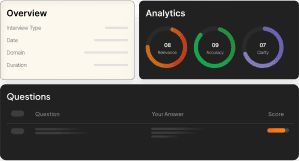

Master preliminary interview questions with proven strategies, sample answers, and expert tips. Boost your chances of landing your next interview.
Top 30 Most Common Preliminary Interview Questions You Should Prepare For
What are behavioral interview questions and why do employers use them?
Answer: Behavioral interview questions ask for past examples to predict future performance by revealing how you actually behaved in real situations.
Employers prefer behavioral questions because they surface evidence of skills, judgment, and cultural fit—more than hypothetical questions do. Behavioral prompts start with phrases like “Tell me about a time when…,” “Give an example of…,” or “Describe how you handled….” They force concise storytelling that shows results, not opinions. For a formal framework and examples, see guidance on behavioral interviewing from industry resources and interview experts. BigInterview and organizational HR guides emphasize using structured stories to reduce bias and increase predictability.
Takeaway: Treat behavioral questions as short case studies—show situation, action, and measurable outcome to prove you can do the job.
What are the most common behavioral interview questions I should prepare?
Answer: The most common behavioral questions ask about teamwork, conflict, deadlines, leadership, failure, and problem solving.
Top questions to prepare (most asked across industries):
1. Tell me about yourself / Walk me through a recent project.
2. Describe a time you showed leadership.
3. Give an example of a challenge you faced and how you handled it.
4. Tell me about a time you failed and what you learned.
5. Describe a difficult team conflict and the resolution.
6. Tell me about a time you met a tight deadline.
7. Give an example when you had to adapt to change.
8. Describe when you went above and beyond for a customer.
9. Tell me about a time you had to persuade someone.
10. Give an example of improving a process.
11. Describe when you handled multiple priorities.
12. Tell me about a time you used data to make a decision.
13. Give an example of mentoring or coaching someone.
14. Describe a time you disagreed with your manager.
15. Tell me about a decision you made with incomplete information. 16–30. Variations focused on initiative, ethics, quality, communication, creativity, cost-saving, cross-functional work, stress-handling, and continuous learning.
Sources like Indeed and The Muse list similar high-frequency prompts and role-specific variations you can tailor.
Takeaway: Build a bank of 8–12 short stories tied to these themes so you can adapt them on the fly.
How do you answer behavioral interview questions using the STAR method?
Answer: Use STAR—Situation, Task, Action, Result—to structure concise, evidence-based stories that hiring managers can easily evaluate.
How to apply STAR:
- Situation: One-sentence set-up (context, scope).
- Task: What you needed to accomplish or the problem to solve.
- Action: Your specific steps—focus on what you did, not the team. Use active verbs and quantify where possible.
- Result: Concrete outcome—numbers, recognition, timeline improvement, lessons learned.
Tips from the MIT STAR guidance: keep the Situation brief, emphasize your unique role in Action, and make Result measurable. Practice trimming stories to 60–90 seconds for preliminary calls and 2–3 minutes for in-depth rounds. Use the STAR structure as a checklist in your head: did I set the scene? Did I highlight my role? Did I provide measurable results and a learning point?
Takeaway: STAR turns anecdote into evidence—practice each story to hit the four elements cleanly.
Can you see sample behavioral interview answers for common prompts?
Answer: Yes—effective sample answers show STAR structure and measurable outcomes. Below are compact examples you can adapt.
Sample: “Tell me about a time you led a project.”
- Situation: Our product release was slipping by two weeks.
- Task: As project lead, I needed to recover the timeline without increasing budget.
- Action: I re-prioritized deliverables, held daily 15-minute stand-ups, and negotiated minor scope deferrals with stakeholders.
- Result: We launched on time with 95% of core functionality; customer satisfaction improved and no extra cost was incurred.
Sample: “Describe a time you resolved conflict on a team.”
- Situation: Two engineers disagreed about the architecture for a new feature.
- Task: As the product manager, I needed consensus to keep development moving.
- Action: I organized a technical pros/cons session, invited a neutral architect to moderate, and set decision criteria based on user impact.
- Result: We selected a hybrid solution that reduced estimated rework by 30% and improved team collaboration.
Sample: “Tell me about a time you failed and what you learned.”
- Situation: I missed a key deadline because I underestimated integration complexity.
- Task: I had to communicate impact and correct the plan.
- Action: I immediately informed stakeholders, proposed a revised timeline with additional QA, and instituted pre-integration checks.
- Result: We recovered within two weeks; I now build buffer time and integration checkpoints into schedules.
For more examples and templates that map to roles, see curated answer lists from BigInterview and The Muse.
Takeaway: Convert your experience into compact STAR stories with measurable outcomes and a clear learning point.
How do I answer conflict, teamwork, and leadership questions effectively?
Answer: Show your role, communication strategy, and the resolution; emphasize collaboration and measurable impact.
Conflict and teamwork answers should:
- Define your role clearly (initiator, mediator, implementer).
- Describe how you listened and validated others’ points.
- Explain the specific actions you took to reach consensus (compromise, escalation, process change).
- Quantify the result (reduced defects, faster delivery, improved morale).
Leadership answers should show initiative, delegation, and coaching—give examples of how you empowered others and measured success (retention, throughput, revenue). For healthcare or highly regulated industries, combine leadership with adherence to protocols and patient/client outcomes (see nursing-focused guidance for scenario-based responses).
Takeaway: Interviewers want to see process and impact—show how your communication and decisions moved the team forward.
What behavioral interview questions should customer service and nursing candidates prepare for?
Answer: Customer service and nursing roles focus on empathy, communication, conflict resolution, ethical decisions, and stress management.
Customer service examples:
- Tell me about handling an irate customer and turning the situation around.
- Describe when you exceeded a customer’s expectations.
Nursing examples:
- Give a time you prioritized multiple patients under pressure.
- Describe handling a medical error or ethical dilemma.
Role-focused resources offer tailored scenarios and expected competencies: check the nursing behavioral guidance from Rutgers Nursing and role-specific question banks for customer service in broader interview libraries like BigInterview.
Takeaway: Prepare stories that show compassion, clinical or service judgment, and measurable patient/customer outcomes.
How should I prepare for behavioral interviews in one week?
Answer: Prioritize story-building, practice with timeboxing, and rehearse delivery using STAR.
Seven-day prep plan:
- Day 1: Inventory your experience—list 10–12 situations covering teamwork, conflict, leadership, failure, initiative, and results.
- Day 2: Draft STAR stories for each; emphasize quantifiable results.
- Day 3: Edit stories to 60–90 seconds; remove jargon.
- Day 4: Do mock interviews with a friend or record yourself; focus on clarity and demeanor.
- Day 5: Review company values and match two stories to each core value.
- Day 6: Prepare role-specific examples (technical, customer, compliance).
- Day 7: Rest, do a light rehearsal, and prepare 3 questions to ask the interviewer.
Use online guides and interactive tools to simulate interviews and get feedback; structured preparation saves time and increases confidence, as recommended by interview experts on platforms like Indeed and BigInterview.
Takeaway: Systematic story prep and short mock sessions convert last-minute panic into polished answers.
What technical or skills assessments do behavioral interviews include?
Answer: Behavioral interviews often pair with skills assessments to validate claimed competencies—expect role-specific tasks and questions about how you applied skills.
Examples:
- Engineers: describe debugging a hard production issue or a code review conflict; pair with a coding test.
- Analysts: explain how you used data to influence a decision; expect case or take-home analysis.
- Nurses: describe a clinical prioritization scenario; expect simulation or scenario-based assessments.
- Sales: explain a lost deal and the follow-up; pair with role-play.
Institutions such as SJSU and other career centers highlight integrating behavioral prompts with skill-focused evaluations to test both process and outcome. See general frameworks that blend critical thinking and communication for assessments on SJSU’s career resources.
Takeaway: Prepare both stories and portfolio/evidence (samples, dashboards, case notes) that show how you applied your technical skills.
How do companies structure preliminary interview rounds and what should I expect?
Answer: Preliminary interviews are usually short—screening calls or video assessments that check fit, communication, and core competencies before technical or onsite rounds.
Common structure:
- Recruiter screen (15–30 min): role fit, salary range, logistics.
- Hiring manager brief (20–45 min): core behavioral questions and role expectations.
- Technical or case screen (30–90 min): role-specific evaluation.
- Final rounds: deeper behavioral, cultural fit, and skill assessments.
Use company-specific research (Glassdoor, company career pages) and general process guides to estimate number and length of rounds. Early rounds favor concise STAR stories and clear statements of interest. Resources like The Muse and Indeed offer guidance on matching story length to the stage.
Takeaway: Match depth of answer to the round—concise for screens, more detail and evidence for later rounds.
How do you answer “Tell me about yourself”, employment gaps, and “Why should we hire you?”
Answer: Be concise, forward-focused, and tie your story to the role’s needs using one or two STAR-ready examples.
“Tell me about yourself”:
- 30–60 second pitch: present (current role/strength), past (relevant background), future (why this role).
Employment gaps:
- Be honest, explain briefly (caregiving, training, market conditions), and pivot to skills or projects you completed during the gap.
“Why should we hire you?”:
- Combine unique strengths with evidence: “I bring X years + specific impact (quantified) + how I’ll address this role’s top priority.”
Practice phrasing to avoid rambling and to emphasize impact. BigInterview and The Muse offer templates to craft concise professional narratives and to link stories to job needs.
Takeaway: Use a short narrative arc and plug in one STAR example to prove your primary claim.
How should you handle stress, failure, and tough questions during interviews?
Answer: Acknowledge, focus on action and learning, and provide concrete changes you made afterward.
When asked about stress or failure:
- Briefly describe the situation and your specific error or stressor.
- Highlight steps you took to mitigate impact and what you learned.
- End with the improvement you implemented (process change, time management, support systems).
Hiring teams want resilience and self-awareness. Use one learning-oriented example and avoid blaming language. Interview guidance from university career centers underscores framing setbacks as learning opportunities with specific follow-up actions.
Takeaway: Show self-awareness, corrective action, and measurable improvement to turn setbacks into strengths.
How Verve AI Interview Copilot Can Help You With This
Answer: Verve AI acts as a real-time co-pilot to analyze interview prompts, suggest STAR-structured responses, and help you stay calm and clear under pressure.
Verve AI listens to the question, identifies the intent (behavioral, technical, or situational), and offers a concise STAR outline or phrasing you can use live or in practice sessions. Verve AI provides pacing cues, reminds you to quantify results, and offers alternative examples when your first story doesn’t match the prompt. Try Verve AI Interview Copilot to practice adaptive answers, get instant structure feedback, and build confidence before and during interviews.
Takeaway: Use contextual prompts and real-time structure suggestions to keep your answers focused, measurable, and calm.
What Are the Most Common Questions About This Topic
Q: What is a behavioral interview question? A: A prompt that asks for a past example to judge future performance.
Q: How long should a STAR answer be? A: 60–90 seconds for screens; up to 2–3 minutes for deeper rounds.
Q: Can I reuse the same story for multiple questions? A: Yes—adapt the emphasis (leadership, result, learning) for each prompt.
Q: Should I mention team contributions in my STAR answer? A: Yes—credit teammates but highlight your specific actions.
Q: How many stories should I prepare? A: 8–12 versatile STAR stories covering core themes.
Q: Can AI tools help with behavioral interview prep? A: Yes—AI can help structure answers, simulate questions, and give pacing feedback.
Conclusion
Behavioral interviews reward preparation, clarity, and measurable results. Build a compact library of STAR stories, practice them to fit different rounds, and tailor examples to the company and role. Structured practice reduces anxiety and improves persuasion—so you show evidence, not just assertions. Try Verve AI Interview Copilot to practice adaptive STAR responses, simulate realistic prompts, and enter interviews with greater confidence.
James Miller
Career Coach