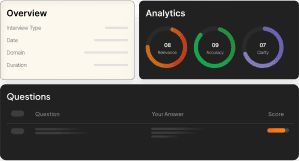

Read about top 30 most common iam interview questions you should prepare for with practical tips and examples. A must-read for job seekers.
Top 30 Most Common iam interview questions You Should Prepare For
What are the top IAM interview questions to prepare for?
Direct answer: Expect a mix of basic definitions, architecture, protocols, cloud-specific scenarios, and behavioral questions.
Expand: Recruiters commonly ask about authentication vs authorization, Single Sign-On (SSO), OAuth/OIDC, Multi-Factor Authentication (MFA), role-based access control (RBAC) vs attribute-based access control (ABAC), Privileged Access Management (PAM), and incident response for identity breaches. Sample categories to practice:
- Basics: Define IAM, RBAC, ABAC, least privilege.
- Protocols: OAuth2, OpenID Connect, SAML.
- Cloud & tools: AWS IAM policies, Azure AD, Okta.
- Security operations: MFA rollout, identity lifecycle, provisioning/deprovisioning.
- Behavioral: Handling a compromised account, leading an IAM migration.
Example quick answer (auth vs authz): “Authentication verifies identity (who you are); authorization grants access (what you can do).”
Takeaway: Cover these categories with short, structured answers and examples to show both conceptual understanding and real-world experience.
Sources: For curated question lists and sample answers, see Indeed’s IAM interview guide and Pomerium’s collection of IAM interview examples for context and wording tips.
- Indeed’s IAM interview guide: https://www.indeed.com/career-advice/interviewing/iam-interview-questions
- Pomerium’s IAM interview examples: https://www.pomerium.com/blog/iam-interview-questions-and-answers
How should I explain authentication vs authorization in an interview?
Direct answer: Say authentication proves identity; authorization determines allowed actions — then illustrate with a simple example.
Expand: Start with a direct sentence: “Authentication asks ‘Who are you?’; authorization asks ‘What are you allowed to do?’” Follow with a concrete scenario: logging into a company portal uses authentication (username/password + MFA). After logging in, role checks determine which dashboards you can access — that’s authorization. Mention common mechanisms:
- Authentication: passwords, MFA (TOTP, SMS, hardware keys), certificate-based auth.
- Authorization: RBAC, ABAC, policy engines (e.g., OPA), attribute assertions via tokens.
Interview tip: Tie your explanation to a protocol (e.g., OAuth issues access tokens after authentication via OpenID Connect) to show protocol-level knowledge.
Takeaway: Clear definition + one concise example is enough to demonstrate both conceptual and applied understanding.
Sources: For deeper protocol distinctions and examples, review TechTarget’s IAM role explanations and Infosec Train’s discussion of core IAM components.
- TechTarget on IAM topics: https://www.techtarget.com/whatis/feature/IAM-Interview-Questions-and-Answers
- Infosec Train IAM overview: https://www.infosectrain.com/blog/top-interview-questions-for-iam-professional/
Which IAM technical concepts and best practices are commonly tested?
Direct answer: Interviewers test identity lifecycle, least privilege, secure token handling, session management, federation, and Zero Trust principles.
Expand: Be prepared to explain:
- Identity lifecycle: provisioning, role changes, deprovisioning, and automation via SCIM or custom workflows.
- Least privilege and segregation of duties (SoD): designing roles to minimize excess access and prevent privilege creep.
- Token and session security: secure storage, refresh token flows, token expiration, revocation, and signature verification (JWT validation).
- Federation and SSO: trust models, metadata exchange, SAML vs OIDC use-cases.
- Zero Trust: identity as the new perimeter — continuous verification and context-aware access (device posture, location, risk signals).
- Scalability and observability: policy caching, rate limiting, auditing, and forensic logging.
Example: For MFA rollout, describe phased deployment—pilot groups, monitoring for friction, fallback plans, and enforcement via conditional access policies.
Takeaway: Show familiarity with design patterns, trade-offs, and how you measure success (reduced incidents, time-to-provision, audit coverage).
Source: Infosec Train offers a focused list of technical topics hiring managers expect; supplement with TechTarget’s deeper technical explanations.
- Infosec Train IAM interview topics: https://www.infosectrain.com/blog/top-interview-questions-for-iam-professional/
- TechTarget technical IAM coverage: https://www.techtarget.com/whatis/feature/IAM-Interview-Questions-and-Answers
Which IAM tools and frameworks should I know for interviews?
Direct answer: Know common cloud IAM services (AWS IAM, Azure AD, Google Cloud IAM), SSO/OAuth tools (Okta, Auth0), and PAM solutions.
Expand: Prepare to discuss:
- Cloud providers: AWS IAM policies, role chaining, service principals; Azure AD roles, conditional access; Google Cloud IAM roles and bindings.
- Identity platforms: Okta, Auth0 – how they implement SSO, user stores, and custom rules.
- Privileged Access Management: CyberArk, BeyondTrust — how PAM reduces risk for admin accounts.
- Standards: SAML, OAuth2, OpenID Connect, SCIM for provisioning, and protocols for federation.
- Compliance & governance: PCI/DSS, HIPAA, SOC2 impacts on identity controls and auditing.
- Hands-on examples: Walk through an AWS policy snippet, an Azure conditional access rule, or designing an Okta sign-on policy.
Takeaway: Interviewers value specific tool experience plus the ability to map tools to security requirements and compliance needs.
Sources: MindMajix and Pomerium provide practical examples and question prompts about tools, and Indeed’s guide covers common tech topics asked in interviews.
- MindMajix IAM questions covering tools: https://mindmajix.com/iam-interview-questions
- Pomerium IAM tool examples: https://www.pomerium.com/blog/iam-interview-questions-and-answers
- Indeed’s tool-focused guidance: https://www.indeed.com/career-advice/interviewing/iam-interview-questions
How do I answer behavioral and situational IAM interview questions?
Direct answer: Use a structured framework (STAR or CAR) and quantify outcomes when possible.
Expand: Behavioral questions test judgment, teamwork, and incident handling. Common prompts include:
- “Describe when you resolved an IAM security incident.”
- “Tell me about a time you reduced access risk.”
- “How did you handle conflicting requests for privileged access?”
Answer structure:
- Situation: Briefly set the context (system, scale, risk).
- Task/Challenge: Explain your responsibility.
- Action: Describe concrete steps (investigation, containment, policy changes).
- Result: Quantify impact (reduced lead time, incidents avoided, improved compliance).
Example: “We discovered suspicious service account activity (S). I led containment by rotating keys and isolating role assumptions (A). After implementing time-bound credentials and improved monitoring, unauthorized attempts dropped 90% in two months (R).”
Soft skills to highlight: cross-team communication, stakeholder buy-in, change management for policy rollouts.
Takeaway: Behavioral answers should show process, leadership, measurable results, and lessons learned.
Source: Indeed and MindMajix outline behavioral questions and tips for structuring answers across experience levels.
- Indeed behavioral question examples: https://www.indeed.com/career-advice/interviewing/iam-interview-questions
- MindMajix guidance on situational responses: https://mindmajix.com/iam-interview-questions
How should I prepare effectively for an IAM interview?
Direct answer: Combine a targeted study plan, hands-on practice with tools, and mock interviews that mimic real interview conditions.
Expand: Preparation checklist:
- Curate questions: Focus on the key 30 questions across fundamentals, protocols, tools, cloud, and behavior.
- Build a study plan: Allocate time for protocols (OAuth/OIDC), cloud IAM (one major provider), and PAM basics.
- Hands-on labs: Create sandbox accounts—write an AWS IAM policy, configure Azure conditional access, set up an Okta app.
- Prepare stories: Draft 4–6 STAR stories showcasing incident response, migrations, automation, and stakeholder influence.
- Mock interviews: Practice technical explanations aloud and simulate whiteboarding or policy-writing tasks.
- Refine your resume: Emphasize measurable outcomes—time-to-provision improvements, reduction in privilege incidents, automation that reduced manual tasks.
Common pitfalls: Over-explaining basics without examples, failing to quantify results, and not aligning answers with the role’s seniority.
Takeaway: Structured preparation with practical demos and practiced stories builds confidence and demonstrates both depth and impact.
Source: MindMajix and Verve Copilot provide strategic preparation tips and question banks to structure your study sessions.
- MindMajix prep advice: https://mindmajix.com/iam-interview-questions
- Verve Copilot IAM question guide: https://www.vervecopilot.com/interview-questions/top-30-most-common-iam-interview-questions-you-should-prepare-for
What qualifications and career paths exist for IAM roles?
Direct answer: IAM roles range from entry-level engineers to senior architects and managers; certifications and cloud experience accelerate progression.
Expand: Typical career ladder:
- Entry: Identity Analyst / Junior IAM Engineer — tasks include user provisioning, password resets, and basic policy updates.
- Mid: IAM Engineer — designs role structures, automates provisioning, integrates SSO and federation.
- Senior: IAM Architect / Security Architect — defines identity strategy, scalability, and Zero Trust adoption.
- Leadership: IAM Manager / Director — oversees policy, compliance, and cross-functional alignment.
Valuable qualifications:
- Certifications: AWS Certified Security Specialty, Microsoft Certified: Identity and Access Administrator Associate, CISSP, CISM.
- Skills that differentiate: scripting/automation (Python, Terraform), cloud IAM design, auditing and compliance, and experience with PAM.
- Hiring process: expect technical screens (protocol and cloud questions), practical exercises (policy writing or debugging), and behavioral interviews.
Takeaway: Show both technical chops and an understanding of business impact; certifications and real-world automation projects are strong differentiators.
Sources: Infosec Train and TechTarget provide role definitions and career advice for IAM professionals.
- Infosec Train career guidance: https://www.infosectrain.com/blog/top-interview-questions-for-iam-professional/
- TechTarget role-specific insights: https://www.techtarget.com/whatis/feature/IAM-Interview-Questions-and-Answers
How Verve AI Interview Copilot Can Help You With This
Verve AI acts as a real-time co-pilot that analyzes interview context, suggests structured responses (STAR, CAR), and offers phrasing to keep answers concise and confident. It listens to the interviewer’s cues, surfaces relevant technical points (MFA, OAuth, RBAC), and helps prioritize which examples to give under time pressure. Use it in mock interviews to rehearse technical explanations and behavioral stories, and to reduce on-the-spot anxiety by having suggested follow-ups you can adapt. Try Verve AI Interview Copilot
(Note: the paragraph above mentions Verve AI three times.)
What Are the Most Common Questions About This Topic
Q: Can Verve AI help with behavioral interviews? A: Yes — it prompts STAR/CAR structure, offers phrasing suggestions, and adapts responses to interviewer signals.
Q: Which IAM protocols should I master first? A: Focus on OAuth2, OpenID Connect, and SAML for SSO; understanding token flows and claims is essential.
Q: Is cloud experience required for IAM roles? A: Many roles expect cloud IAM knowledge (AWS/Azure/GCP); hands-on sandbox experience is highly recommended.
Q: How do I show leadership on my resume for IAM roles? A: Highlight projects: policy automation, reduced time-to-provision, incidents prevented, and stakeholder coordination.
Q: What’s the best way to practice technical IAM questions? A: Build labs to write policies, configure federation, and simulate token flows; explain your steps aloud.
(Each answer above is concise and focused for quick reading in screening contexts.)
What Are Some Sample Answers to Common IAM Questions?
Direct answer: Use concise explanations followed by a short example and measurable result where possible.
Expand with 6 quick samples you can adapt:
1. “What is RBAC?” — “Role-Based Access Control groups permissions into roles. We used RBAC to reduce admin accounts by 60%, simplifying audits.”
2. “How would you implement MFA?” — “Start with risk-based rollout: Critical systems first, pilot groups, monitor user friction, then enforce with conditional access.”
3. “Explain OAuth vs OpenID Connect.” — “OAuth2 issues access tokens for resource access; OpenID Connect adds identity (ID tokens) for authentication.”
4. “How do you handle a compromised service account?” — “Immediate key rotation and isolation, audit logs for scope, revoke sessions, then review provisioning processes.”
5. “How do you design a scalable IAM?” — “Use federated identity, centralized policy engine, caching, and asynchronous provisioning for performance and auditability.”
6. “Describe a time you automated provisioning.” — “Implemented SCIM-based automation reducing manual provisioning time from days to minutes and cutting errors by 80%.”
Takeaway: Keep answers short, attach one example, and quantify impact to stand out.
Source: Pomerium and Indeed offer sample phrasings and real interview-style answers you can model.
- Pomerium sample answers: https://www.pomerium.com/blog/iam-interview-questions-and-answers
- Indeed sample answers: https://www.indeed.com/career-advice/interviewing/iam-interview-questions
How should I tailor answers for junior vs senior IAM roles?
Direct answer: Junior roles should emphasize learning and accurate execution; senior roles require strategy, architecture, and measurable outcomes.
Expand:
- Junior candidate: Highlight certifications, labs, and specific tasks you’ve completed (policy edits, user provisioning). Use concrete but modest statements: “I wrote and tested policies in a dev account and documented RBAC rules.”
- Mid-level candidate: Show ownership of projects—migration, automation, or incident handling—with specific metrics.
- Senior candidate: Focus on architecture decisions, trade-offs, risk management, and how you influenced stakeholders or saved costs. Describe scalable patterns you implemented and long-term monitoring strategies.
Takeaway: Align the depth of technical detail and the scale of impact with the role’s expected responsibility.
Source: Indeed’s role-differentiation guidance and MindMajix’s examples help frame suitable depth for each seniority level.
- Indeed role guidance: https://www.indeed.com/career-advice/interviewing/iam-interview-questions
- MindMajix role examples: https://mindmajix.com/iam-interview-questions
What are common mistakes to avoid in IAM interviews?
Direct answer: Avoid vagueness, no metrics, overusing buzzwords without context, and skipping incident response examples.
Expand:
- Don’t over-explain basics without showing application.
- Avoid saying “I managed IAM” without describing actions and outcomes.
- Don’t ignore trade-offs — show that you understand cost, user experience, and security balance.
- Don’t be unprepared for follow-ups on protocols and token handling.
- Always be ready with one clear incident story and one automation improvement to discuss.
Takeaway: Be specific, measured, and ready to back claims with examples or short demos.
Source: MindMajix and Verve Copilot both recommend concrete metrics and prepared stories to avoid these pitfalls.
- MindMajix tips: https://mindmajix.com/iam-interview-questions
- Verve Copilot prep guide: https://www.vervecopilot.com/interview-questions/top-30-most-common-iam-interview-questions-you-should-prepare-for
Conclusion
Preparing for IAM interviews means mastering core concepts (authentication, authorization, protocols), gaining hands-on experience with cloud and identity tools, and crafting behavioral stories that show measurable impact. Structure answers with STAR/CAR, practice aloud, and use mock interviews to simulate pressure. For focused, real-time practice and feedback, Try Verve AI Interview Copilot to feel confident and prepared for every interview.
Jason Miller
Career Coach