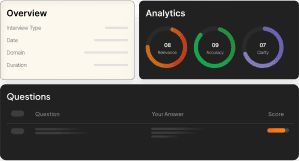

Read about top 30 most common cs interview questions you should prepare for with practical tips and examples. A must-read for job seekers.
Top 30 Most Common CS Interview Questions You Should Prepare For
What are the Top 30 CS interview questions I should study?
Answer: Focus on a balanced mix of algorithms, system design, technical fundamentals, SQL, and behavioral stories.
Here’s a practical, grouped list of 30 high-impact questions to practice, organized by category so you can prioritize study time:
- Data structures & algorithms (10)
1. Two-sum / Hash table usage and edge cases
2. Reverse a linked list (iterative & recursive)
3. Merge two sorted lists / merge sort concept
4. Binary search on sorted arrays
5. Top-k elements / heaps and priority queues
6. Tree traversals and lowest common ancestor (LCA)
7. Graph BFS/DFS and shortest-path concepts
8. Detect cycles in linked list / graph
9. Dynamic programming basics: knapsack / Fibonacci optimization
10. Sliding window / two-pointer problems
- System design (5)
11. Design a URL shortener (storage, API, scaling)
12. Design a chat system or notification service
13. Design a rate limiter for APIs
14. Design a news feed / timeline service
15. Design a distributed file store or simple caching layer
- Behavioral and soft skills (5)
16. Tell me about a time you faced a technical challenge
17. Tell me about a successful project you led
18. Describe a time you disagreed with a teammate
19. Why do you want to work here? / Why this role?
20. How do you prioritize tasks under pressure?
- Technical fundamentals & tooling (5)
21. Explain OOP principles with examples (inheritance, polymorphism)
22. Explain memory management / garbage collection basics
23. Questions on OS basics: locks, threads, processes
24. Networking fundamentals: TCP vs UDP, DNS basics
25. Microservices: pros/cons, idempotency, service discovery
- SQL, debugging, and language-specific (5)
26. Write a JOIN query that aggregates results (grouping, HAVING)
27. SQL window function example (ROW_NUMBER / RANK)
28. Debugging: walk me through how you’d find a production bug
29. Explain big-O time and space for common algorithms
30. Language-specific: constructor/destructor, exceptions, memory model
Why these 30? They reflect repeated themes from major interview guides and candidate reports — algorithmic fluency, system thinking, clear storytelling, and applied technical knowledge. For canonical references and sample answers, see Indeed’s CS interview guide and curated fundamentals lists on Coursera and Adaface. Takeaway: Master this mix and you’ll cover the bulk of what interviewers ask for most CS roles.
Sources: See Indeed’s guide to common CS interview questions, Coursera’s interview Q&A, and Adaface’s fundamentals lists for deeper practice.
Which algorithm and data structure questions are most common in CS interviews?
Answer: Expect arrays, strings, hashing, two-pointers, sorting, binary search, trees, graphs, and dynamic programming repeatedly.
Interviewers often use a small set of patterns to test problem-solving: traversal (DFS/BFS), divide and conquer (binary search, mergesort), greedy or DP for optimization, and hash-based lookups for linear-time solutions. Example: Two-sum can be solved in O(n) time and O(n) extra space using a hash map; a naive nested loop is O(n^2) and usually not acceptable in mid/large-company interviews.
How to practice:
- Tag problems by pattern (e.g., sliding window, DFS) and rotate daily.
- Time-box practice: 30–45 minutes for a medium problem, then review optimizations.
- Always state intended complexity and tradeoffs out loud.
For curated question lists and patterns, consult resources like Adaface’s fundamentals collection and Indeed’s interview question guides. Takeaway: Learn the patterns, not just solutions — pattern recognition is the fastest route to correct answers in interviews.
Sources: Adaface’s fundamentals Q&A, Indeed’s CS interview questions page.
How do I explain time and space complexity clearly in an interview?
Answer: State the algorithmic complexity up front, justify each term, and mention worst/average case and memory tradeoffs.
Use this structure:
1. Give a one-line complexity estimate (e.g., “This runs in O(n log n) time and O(n) extra space.”).
2. Explain why: “We sort the input (O(n log n)), then scan once (O(n)), so total is O(n log n).”
3. Mention space: “We use O(n) extra space for temporary arrays; in-place sort would reduce space but might increase time or complexity of implementation.”
4. Note edge cases and input limits, and whether average or worst-case matters for the role.
Example: Binary search is O(log n) time, O(1) space. Hash-map lookup is O(1) average time but O(n) worst-case depending on collisions — mention tradeoffs if asked.
Why interviewers care: Complexity shows you can reason about scale and tradeoffs. Practice explaining complexity concisely while coding, and summarize at the end. Takeaway: Clear, concise complexity statements with justification demonstrate scalable thinking and polish your interview answers.
Sources: Indeed’s interview guides and Coursera’s explanation-focused Q&A.
How should I structure answers to behavioral questions like “Tell me about a challenging project”?
Answer: Use a structured storytelling framework — STAR (Situation, Task, Action, Result) or CAR (Context, Action, Result) — and quantify outcomes.
How to build a strong STAR answer:
- Situation: One or two lines of context.
- Task: What was expected of you?
- Action: Concrete steps you took; focus on your contributions.
- Result: Measurable outcome, lessons learned, and what you’d do differently.
Example (concise):
- Situation: Our feature rollout caused a 30% latency spike during peak hours.
- Task: I led the performance investigation and remediation.
- Action: Introduced tracing, prioritized hot paths, refactored a synchronous service to be asynchronous, and added backpressure.
- Result: Reduced latency by 45% and improved error rates; delivered a postmortem and process changes to prevent recurrence.
Tip: Practice 8–12 stories covering teamwork, conflict, leadership, failure, and innovation. Use the Tech Interview Handbook for a ready list of behavioral prompts. Takeaway: A few well-practiced, structured stories are far more effective than many unpracticed anecdotes.
Sources: Tech Interview Handbook behavioral list and Career360 interview advice.
What system design and company-specific interview patterns should I expect at top tech firms?
Answer: Expect multi-round processes with focused checkpoints: coding rounds, system design (mid/senior), and behavioral interviews.
Typical structure:
- Early rounds: algorithmic coding through phone screens or online assessments.
- Mid rounds: full coding interviews (whiteboard or shared editor).
- Later rounds: system design for mid/senior roles, deeper technical deep-dive and behavioral/culture interviews.
Company-specific patterns:
- Google tends to emphasize algorithms and scalability; ask open-ended design questions requiring tradeoff analysis.
- Amazon emphasizes leadership principles and behavioral fit alongside technical content.
- Microsoft often mixes practical system design with language/OS questions.
Sample mid-level system design prompts:
- Design a rate-limited API gateway.
- Design image upload and CDN distribution pipeline.
- Design an e-commerce order processing system with idempotence and retries.
Preparation tip: Tailor answers to the company’s culture. Use examples that align with stated principles (e.g., Amazon’s leadership principles). See real candidate experiences on platforms consolidated by Indeed and Coursera to calibrate expectations. Takeaway: Study both breadth (process) and depth (role-specific questions); align examples to target company culture.
Sources: Indeed’s company interview overviews and Coursera’s employer-focused breakdowns.
What SQL and database questions are commonly asked, and how should I answer them?
Answer: Be ready to write joins and aggregates, demonstrate window functions, explain normalization, and discuss indexes and transactions.
Typical SQL questions:
- Write a query to find the top N customers by purchase amount using GROUP BY and ORDER BY.
- Show how to use window functions to rank rows without aggregation (ROW_NUMBER, RANK).
- Explain how you would tune a slow query — describe indexes, query plans, and denormalization tradeoffs.
- Describe ACID properties and isolation levels for transactions.
Sample query (top customers): SELECT customerid, SUM(amount) AS totalspent FROM purchases GROUP BY customerid ORDER BY totalspent DESC LIMIT 10;
Practice with real datasets and timed exercises. Be prepared to explain your query choices and complexity (e.g., why an index helps or when a full table scan is unavoidable). Career360 and CV Owl provide example Q&A and sample SQL prompts for practice. Takeaway: Demonstrate both query-writing fluency and the ability to explain tradeoffs and performance tuning.
Sources: Career360 SQL examples, CV Owl interview Q&A.
How should I prepare for system design for mid-level roles?
Answer: Focus on concrete scoping, APIs, data modeling, scaling strategies, and tradeoffs—practice end-to-end designs.
A practical approach:
- Clarify requirements and constraints first (functional and non-functional).
- Sketch a high-level architecture (components, data flow, storage).
- Discuss data modeling choices (SQL vs NoSQL), consistency, and partitioning strategies.
- Address scaling: replication, sharding, caching, load balancing.
- Consider reliability: retries, idempotency, monitoring, and failure modes.
Example scope: Designing a notification service—define throughput needs, latency targets, persistence, deduplication, and delivery guarantees. Walk through choices like using Kafka for buffering, Redis for deduplication, and a push worker fleet for delivery.
Use resources such as Coursera’s employer-focused guides and practical design problems from Indeed to practice. Takeaway: Practice scoping and justifying tradeoffs—interviewers are evaluating reasoning, not perfect diagrams.
Sources: Coursera system design guidance, Indeed system design recommendations.
How far in advance and how should I plan my interview preparation?
Answer: Start 6–8 weeks before applications for focused preparation; earlier if transitioning fields or skill gaps exist.
Study plan example (8-week sprint):
- Weeks 1–3: Core algorithms and data-structure patterns; daily 60–90 min coding.
- Weeks 4–5: System design basics and one end-to-end design per day; review design tradeoffs.
- Week 6: SQL, OS, networking, and language-specific fundamentals.
- Weeks 7–8: Mock interviews, timed sessions, behavioral story polishing, and weaknesses remediation.
Daily micro-practice: One medium coding problem, one review of a previously solved problem, 15–30 minutes of system design or SQL. Use mock interview platforms and pair programming to simulate pressure.
Sources like Coursera, Indeed, and Career360 recommend mock interviews, varied problem sets, and iterative review to build confidence. Takeaway: A structured schedule with consistent daily practice beats last-minute cramming.
Sources: Coursera interview tips, Indeed preparation guide, Career360 resources.
How can I practice coding interviews effectively at home?
Answer: Simulate real interview conditions: timed problems, no internet (unless allowed), explain your thought process out loud, and practice with a peer or mock platform.
Actionable steps:
- Use a whiteboard or shared editor to mimic real constraints.
- Time-box problems (30–45 minutes) and verbally narrate your approach.
- After solving, refactor and discuss complexity and edge cases.
- Record mock interviews to analyze pacing, clarity, and gaps.
- Rotate problem types and track patterns you miss to guide targeted study.
Tools and resources: coding practice sites, mock interview platforms, and curated lists from Adaface and Coursera for topic-focused practice. Takeaway: Repeated, realistic simulations build both problem-solving speed and communication skills.
Sources: Adaface practice recommendations, Coursera mock interview guidance.
What are common mistakes to avoid during CS interviews?
Answer: Avoid over-assuming requirements, poor time management, skipping complexity analysis, and weak storytelling in behavioral rounds.
Common pitfalls:
- Not asking clarifying questions before coding.
- Jumping into code without an outline or verbal plan.
- Ignoring edge cases or testability.
- Over-optimizing prematurely rather than delivering a correct baseline.
- Rambling or failing to tie behavioral answers to measurable outcomes.
Fixes: Ask clarifying questions up front, outline the solution, code a correct version, then optimize and test. Practice concise storytelling for behavioral questions. Takeaway: Small behavioral and communication fixes often yield large interview improvements.
Sources: Indeed interview prep and Coursera interview best practices.
How do I explain object-oriented design questions succinctly?
Answer: Define the main classes, relationships, key methods, and responsibilities; justify design patterns you choose.
Approach:
- Identify core entities and their responsibilities (Single Responsibility Principle).
- Sketch relationships (inheritance vs composition) and major interfaces.
- Highlight extensibility and how you’d add features.
- Mention tradeoffs: coupling, testability, and performance.
Example: For a media player, classes might include Player, Playlist, MediaItem, and Decoder. Use composition for decoder implementations and interfaces for pluggable components. Takeaway: Clear responsibilities and tradeoffs show design maturity.
Sources: Indeed’s OOP and architecture guidance, Coursera fundamentals.
How Verve AI Interview Copilot Can Help You With This
Verve AI Interview Copilot acts like a quiet co-pilot in real interviews: it analyzes question context, suggests succinct phrasing, and nudges structure (STAR, CAR, or STAR‑style steps for technical answers). Verve AI highlights complexity and tradeoffs while offering phrasing templates you can adapt on the fly. It also offers calming prompts to keep your pace steady and your answers clear, helping you present polished, confident responses under pressure.
What Are the Most Common Questions About This Topic
Q: Can Verve AI help with behavioral interviews? A: Yes — it uses STAR/CAR frameworks, suggests concise phrasing, and coaches delivery to keep you clear and confident.
Q: How long should I study before applying? A: Aim for 6–8 weeks of consistent prep: mix daily coding, system design reviews, and mock interviews weekly.
Q: What algorithm topics should I master? A: Arrays, strings, hashing, two‑pointers, sorting, binary search, trees, graphs, dynamic programming, and greedy methods.
Q: Will mid-level interviews include system design? A: Yes — mid-level roles include scoped design questions on APIs, data modeling, scaling, caching, and tradeoffs.
Q: How to prep SQL questions quickly? A: Practice joins, GROUP BY, window functions, indexes, and transactions with real sample datasets and timed exercises.
Final tips to maximize interview performance
- Prioritize patterns over isolated problems: learn sliding window, two‑pointers, DFS/BFS, DP, and greedy patterns.
- Practice structured storytelling (STAR/CAR) for behavioral rounds and quantify outcomes.
- Simulate interview conditions regularly and review mistakes deliberately.
- Review system design by scoping problems, sketching architectures, and justifying tradeoffs out loud.
- Use reputable resources to guide practice: Indeed’s comprehensive lists, Coursera’s focused articles, Adaface’s fundamentals, and behavioral prompts from Tech Interview Handbook.
For more real-time, context-aware support during practice or live interviews, try Verve AI Interview Copilot to feel confident and prepared for every interview.
Jason Miller
Career Coach