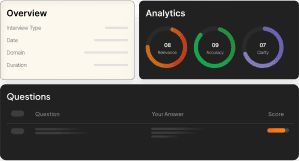

Read about top 30 most common cloud engineer you should prepare for with practical tips and examples. A must-read for job seekers.
Top 30 Most Common cloud engineer You Should Prepare For
What are the top 30 cloud engineer interview questions I should prepare for?
Direct answer: Prepare a balanced mix of architecture, platform-specific, security, automation, troubleshooting, and behavioral questions — thirty of them across those categories.
Top 30 (grouped for focused practice)
- Architecture & Design
1. Explain a multi-tier cloud architecture you designed.
2. How do you design for high availability and fault tolerance?
3. How would you scale a stateful application in the cloud?
4. Describe trade-offs between microservices and monoliths in the cloud.
- Platform Fundamentals (AWS/Azure/GCP)
5. When would you use S3 vs EBS (or equivalent) for storage?
6. Describe VPC/subnet/networking basics and routing patterns.
7. Explain load balancer types and when to use each (ALB/NLB).
8. How do you manage secrets and config in cloud services?
- Security & Compliance
9. Explain Identity and Access Management (IAM) best practices.
10. How do you secure data at rest and in transit?
11. How would you handle a breach or compromised credentials?
12. What compliance frameworks (e.g., GDPR, HIPAA) affect cloud design?
- Automation & DevOps
13. How do you design CI/CD pipelines for cloud deployments?
14. What tools do you use for infrastructure as code and why?
15. How do you manage environment drift and rollbacks?
16. Explain blue/green and canary deployment strategies.
- Observability & Troubleshooting
17. How do you instrument applications for logging and metrics?
18. Walk me through diagnosing a production outage in the cloud.
19. How do you set SLOs, SLIs, and alerts to avoid alert fatigue?
20. How would you investigate high latency between services?
- Cost & Performance Optimization
21. How do you estimate and optimize cloud costs?
22. When do you use serverless vs. containers vs. VMs for cost/perf?
23. Explain autoscaling policies and cost trade-offs.
24. How do you right-size instances and manage reserved capacity?
- Behavioral & Scenario-Based
25. Describe a time you resolved a complex cloud outage.
26. Tell me about a project where you reduced costs or improved reliability.
27. How do you handle conflicting priorities with stakeholders?
28. Provide an example of mentoring a junior cloud engineer.
- Resume & Career Fit
29. Which certifications and projects best showcase cloud expertise?
30. How do you quantify impact from your cloud initiatives on your resume?
Example: for question 18 (diagnosing an outage), structure your answer briefly (what you observed), actions taken, stakeholders communicated with, and the root cause plus prevention steps.
Takeaway: Cover these 30 grouped questions with concise, structured answers and measurable outcomes to show both technical depth and real-world impact.
Which technical skills and topics are most tested in cloud engineer interviews?
Direct answer: Interviewers test cloud architecture, networking, storage, compute models, automation (IaC/CI-CD), observability, security, and cost optimization.
What hiring teams look for
- Core cloud services: compute, networking, storage, managed databases.
- Networking: VPCs, routing, NAT, VPN, peering, DNS.
- Compute concepts: containers vs VMs vs serverless and lifecycle management.
- Automation: Terraform, CloudFormation, ARM templates, Ansible, CI/CD.
- Observability: logging, distributed tracing, metrics, alerting (Prometheus/CloudWatch).
- Security: IAM roles/policies, key management, encryption, compliance considerations.
- Performance & cost: autoscaling, caching, right-sizing, reserved vs spot capacity.
Practical preparation tip: build a small end-to-end project (infrastructure as code + CI/CD + monitoring + cost report) and be ready to explain design trade-offs and metrics. For reference, many curated lists and question sets map to these topics — see interview templates and question banks from trusted sources like Talentlyft and Finalround AI for specifics and examples.
Citations: For detailed topic lists and sample questions, see Talentlyft’s cloud interview template and Finalround AI’s question collection.
- Talentlyft’s cloud engineer interview questions for frameworks and examples.
- Finalround AI’s cloud engineer guide for typical technical themes.
Takeaway: Focus study time on architecture, automation, security, and observability — and tie answers to business impact.
How should I structure answers to behavioral and scenario-based cloud engineer questions?
Direct answer: Use a structured framework like STAR (Situation, Task, Action, Result) or CAR (Context, Action, Result) and include measurable outcomes and lessons learned.
How to apply STAR/CAR for cloud scenarios
- Situation/Context: Briefly set the scene (system, scale, and users affected).
- Task: Define your responsibility or goal (restore service, reduce cost, implement DR).
- Action: Explain concrete technical steps (commands, tools, runbooks, stakeholders you coordinated with). Be specific about your role.
- Result: Share quantifiable outcomes: reduced MTTR by X%, saved $Y/month, improved latency by Z ms. Also mention follow-up actions (postmortem, automation, runbook updates).
Example answer sketch:
- S: “Our API tier failed during peak traffic, causing 40% error rate.”
- T: “I led incident response to restore throughput and prevent recurrence.”
- A: “Performed autoscaler tune, replaced unhealthy instances, patched memory leak, and added better health checks.”
- R: “Service recovered in 12 minutes; MTTR reduced by 60% in following quarter after automation.”
Citations: For sample behavioral prompts and STAR-based formats consult Talentlyft and Indeed’s interview guidance for cloud roles.
- Talentlyft emphasizes STAR for cloud engineer scenarios.
- Indeed provides behavioral question examples and answer patterns.
Takeaway: Always structure answers, quantify impact, and highlight what you automated or changed to prevent recurrence.
What does the typical cloud engineer interview process look like and how many rounds should I expect?
Direct answer: Expect 3–5 stages: resume screen, technical phone/video screen, hands-on assessment or coding/design exercise, onsite or final loop (system design + behavioral), and a hiring manager/HR debrief.
Common interview stages explained
- Resume & recruiter screen: high-level fit, projects, and availability.
- Technical phone/video screen: whiteboard-style questions or live problem-solving on architecture, networking, or Linux basics.
- Take-home assignment or live lab: a short project or cloud-based task (deploy infra, fix issues, create CI pipeline).
- Onsite/final loop: deeper system design, platform-specific questions (AWS/Azure/GCP), and behavioral interviews with cross-functional partners.
- Offer stage: compensation and reference checks.
Prep tips per stage
- Phone screen: rehearse concise technical summaries and one clear project story.
- Take-home: treat it like a portfolio piece — document assumptions and tests.
- Onsite: focus on system design diagrams, trade-offs, and aligning answers with company scale and constraints.
Citations: Finalround AI and Turing provide good breakdowns of typical interview rounds and test formats for cloud candidates.
- Finalround AI covers rounds and sample assessments.
- Turing summarizes common interview stages for cloud roles.
Takeaway: Map your prep to each stage: concise stories for screens, reproducible projects for take-homes, and deep trade-off justification for design loops.
Which AWS, Azure, and GCP platform-specific questions should I prepare for?
Direct answer: Prepare platform fundamentals (networking, storage, compute), key managed services, identity, and pricing models for the specific cloud you’re interviewing for.
Platform-focused question areas and examples
- AWS: S3 vs EBS vs EFS, VPC and routing tables, IAM policies and roles, RDS vs Aurora, CloudFormation/Terraform, CloudWatch, ECS/EKS/Lambda, ELB types. Example: “How does S3 consistency model affect read-after-write?”
- Azure: Resource Groups, Azure VNet, Azure AD roles and managed identities, Azure Blob vs Disk, App Service vs AKS, ARM templates. Example: “How do you integrate Key Vault with AKS secrets?”
- GCP: VPC design, GCS vs Persistent Disks, IAM roles and service accounts, GKE autoscaling, Cloud Functions, Stackdriver/Cloud Monitoring. Example: “How do you secure inter-service communication in GKE?”
Certifications & expectations
- Employers often value practical experience more than certifications, but certs signal baseline knowledge. Relevant certs: AWS Certified Solutions Architect/DevOps Engineer, Azure Administrator/Engineer, Google Professional Cloud Engineer. Be ready to discuss real-world implementations, not just exam facts.
Citations: For platform-specific question examples and guidance, see Braintrust and Talentlyft’s categorized question sets.
- Braintrust lists AWS/Azure/GCP focused questions and practical scenarios.
- Talentlyft provides platform-focused interview templates.
Takeaway: Study the managed services and identity models for your target cloud and be ready to explain trade-offs with real examples.
What cloud security and compliance topics are commonly asked in interviews?
Direct answer: Expect questions about IAM, encryption, network segmentation, key management, secure deployment pipelines, incident response, and regulatory compliance.
Common security topics and how to answer
- IAM: least privilege, role vs user policies, cross-account access, and temporary credentials. Provide examples of tightening access (policy changes, role assumption).
- Encryption: KMS/Key Vault usage, envelope encryption, in-transit (TLS) and at-rest encryption strategies. Describe how keys are rotated and audited.
- Network security: VPC segmentation, security groups/NACLs, private endpoints, bastion hosts, and zero-trust approaches.
- Secure CI/CD: signing artifacts, secret scanning, managing secrets with vaults, and immutability.
- Incident response & DR: runbooks, RTO/RPO targets, backups, and chaos-testing strategies.
Compliance: Be prepared to discuss how you would design for GDPR, HIPAA, or SOC 2 requirements — e.g., data residency, logging, retention policies, and audit trails.
Citations: Braintrust and Indeed offer focused security interview guides and questions for cloud roles.
- Braintrust covers IAM, auditing, and compliance-related scenarios.
- Indeed outlines typical cloud security interview prompts and suggested focal points.
Takeaway: Demonstrate concrete controls, auditability, and post-incident improvements — security answers should emphasize prevention and measurable monitoring.
How can I highlight relevant cloud skills on my resume and stand out in interviews?
Direct answer: Quantify outcomes, show end-to-end projects (IaC, CI/CD, monitoring), list platform skills and tooling, and emphasize collaborative results and leadership.
Resume and portfolio strategies
- Lead with impact: “Reduced monthly cloud spend by 32% by rightsizing and reserved instances ($20K/year savings).”
- Tools & tech: list cloud providers and core services, IaC tools (Terraform/CloudFormation), containers (Docker, Kubernetes), CI/CD (Jenkins/GitHub Actions), and monitoring (Prometheus, CloudWatch).
- Projects: include links to repos, architecture diagrams, or deployed demos. Make take-home assignments or public repos clean and documented.
- Certifications: list relevant certs but pair them with real project experience.
- Soft skills: highlight incident leadership, cross-team projects, mentoring, and communication.
Interview prep: tailor your top 3 project stories for the role — scalability problem, cost optimization, and a security or compliance improvement — with clear metrics and code/infra artifacts if possible.
Citations: Indeed and Teal provide resume tips and role-tailoring advice for cloud engineers.
- Indeed’s career advice recommends measurable outcomes and clear technical stacks.
- Teal provides templates and targeted phrasing for cloud resumes.
Takeaway: Use metrics, publishable work, and role-specific keywords to get past ATS and to create memorable interview talking points.
How Verve AI Interview Copilot Can Help You With This
Verve AI helps you in live interviews by analyzing the question context and suggesting concise, structured phrasing that fits STAR or CAR. Verve AI offers real-time prompts to keep answers measurable and on-topic, helping prioritize what to say when time is limited. Try Verve AI Interview Copilot as a quiet co-pilot that reduces anxiety and prompts follow-ups and clarifying questions so you stay calm and articulate.
What Are the Most Common Questions About This Topic
Q: Can Verve AI help with behavioral interviews? A: Yes — it uses STAR/CAR templates to guide timing, quantify impact, and suggest follow-up clarifications.
Q: How should I prepare for platform-specific cloud questions? A: Study key services, common pain points, and build a demo project showing architecture, IaC, and CI/CD pipelines.
Q: Will interviewers ask about cost optimization? A: Frequently — expect questions on rightsizing, reserved vs spot instances, autoscaling, and tagging for chargebacks.
Q: What’s the best way to show security knowledge in interviews? A: Describe IAM least-privilege, encryption strategies, logging/auditing, and a concrete remediation you implemented.
Q: How many rounds do cloud interviews usually include? A: Typically 3–5: recruiter screen, technical screen, take-home or coding, onsite design loop, and manager/Hiring decision.
(Note: The answers above are concise but practical; pair each with an example story for interviews.)
What Are the Most Common Questions About This Topic
Q: Can Verve AI help with behavioral interviews? A: Yes — Verve AI guides you to use STAR/CAR, prompts key impact metrics, and suggests clarifying points in real time.
Q: How should I prepare for platform-specific cloud questions? A: Build short projects, document IaC, and practice explaining trade-offs between managed services and custom stacks.
Q: Will interviewers ask about cost optimization? A: Yes — be ready to discuss autoscaling, reserved instances, spot usage, and tagging strategies with outcomes.
Q: What’s the best way to show security knowledge in interviews? A: Present concrete controls: IAM roles, KMS usage, network segmentation, monitoring, and an incident postmortem.
Q: How many rounds do cloud interviews usually include? A: Expect multiple stages: phone screen, tech screen, hands-on eval, in-person/loop, and manager/offer discussion.
(Note: The above Q&A pairs are intended for quick reference; practice concise versions of each for screening calls.)
What Are the Most Common Questions About This Topic
Q: Can Verve AI help with behavioral interviews? A: Yes — it uses STAR and CAR frameworks to guide real-time answers and suggest measurable metrics.
Q: How do I prepare for system design interviews? A: Sketch diagrams, define components and trade-offs, and rehearse scaling and failure scenarios aloud.
Q: Should I bring a portfolio to interviews? A: Yes — a documented repo or architecture diagram can differentiate you and support your answers.
Q: How do I explain a past incident? A: Use STAR: describe the issue, your role, actions taken, and the measurable outcome and follow-up.
Q: Which certifications are most valuable? A: AWS Solutions Architect and DevOps or equivalent Azure/GCP certs help, but practical projects matter most.
Conclusion
Recap: Focus your prep on the six core areas: technical fundamentals, platform-specific services, security and compliance, automation and DevOps, observability and troubleshooting, and behavioral storytelling. Use structured answer frameworks (STAR/CAR), quantify outcomes, and package your work as reproducible projects. Preparation, structure, and real examples create confidence and make your answers memorable.
Try Verve AI Interview Copilot to feel confident and prepared for every interview — it can help you practice, structure, and deliver stronger answers in real time. Good luck — steady preparation and clear storytelling win interviews.
Jason Miller
Career Coach